.png)

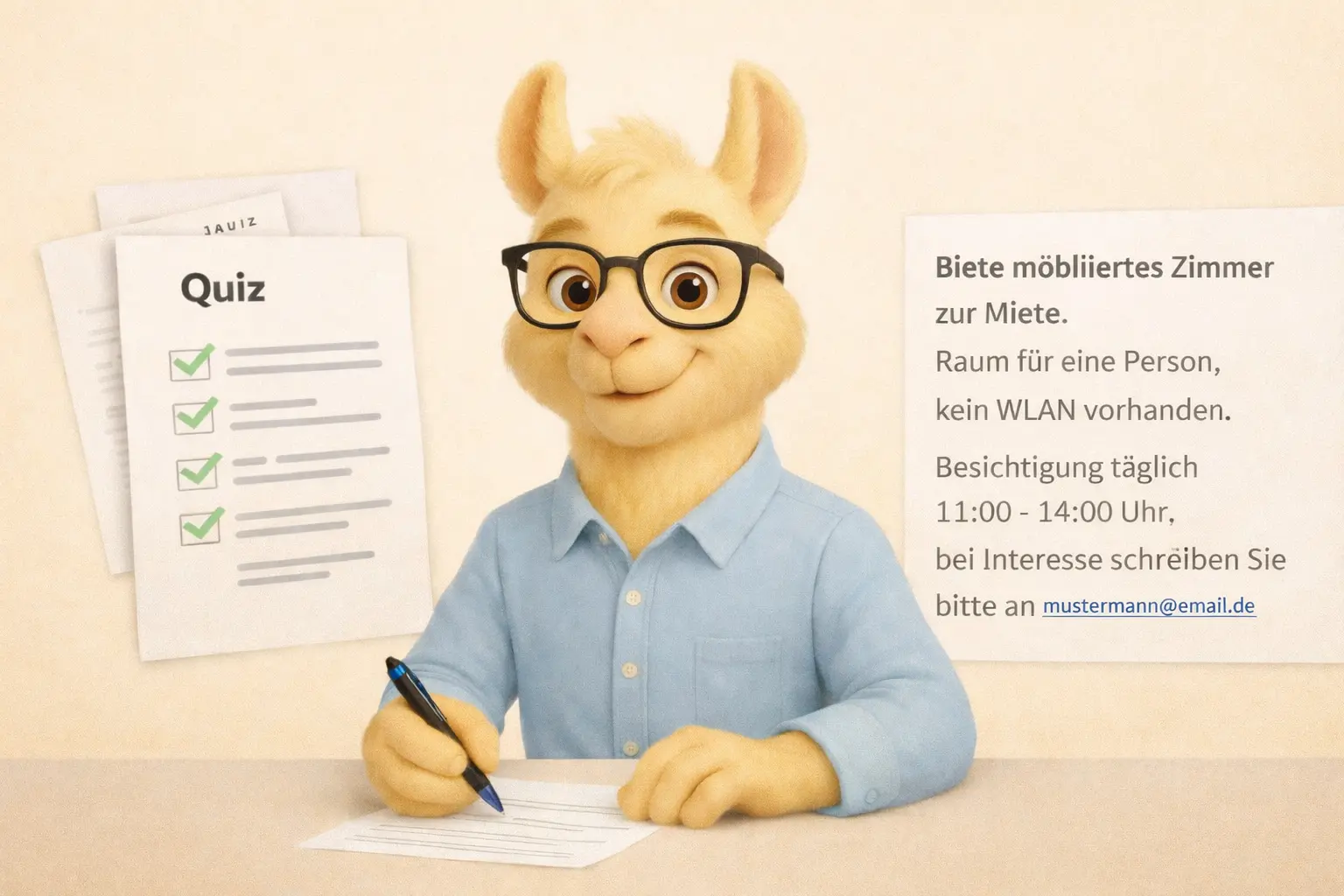
You Have 65 Minutes, 30 Questions, and Zero Dictionaries. Here's the Plan.
Most candidates walk into Goethe B1 Lesen doing the same thing: they start at Teil 1, read the text word by word, then move to the questions. By the time they reach Teil 4, they have 12 minutes left and 14 questions to answer.
The result? Panicked guessing on the hardest sections.
The Lesen module isn't testing whether you understand every German word. It's testing whether you can find specific information under time pressure. That requires strategy, not just vocabulary.
This guide gives you exactly that: the structure of every Teil, the step-by-step approach for matching and multiple choice tasks, a 65-minute time plan, and the specific traps that cost candidates points every exam.
What Exactly Is Goethe B1 Lesen? (Format, Scoring, Rules)
The Lesen module is one of four sections in the Goethe-Zertifikat B1 exam (alongside Hoeren, Schreiben, and Sprechen). You can take modules together or separately.
Here are the facts you need:
- Duration: 65 minutes
- Total questions: 30 (across 5 parts)
- Aids allowed: None. No dictionary, no phone, no notes brought in.
- Starting order: You can begin with any part and you should use this to your advantage.
Each correct answer earns 1 point. Your raw score (0-30) is converted to a 0-100 scale by multiplying by 3.33 and rounding.
To pass Lesen, you need 60 points which means 18 correct answers out of 30.
That is 60%. You can get 12 questions wrong and still pass. This changes how you should approach the exam: perfection is not the goal. Strategic point collection is.
Key insight: Teil 3 (matching ads) and Teil 5 (rules) are the most mechanical - they reward scanning and attention to detail, not deep reading. These are your safest points. Teil 2 and Teil 4 are the most time-consuming because they require understanding arguments and opinions.
Part-by-Part: What to Expect and How to Approach Each Teil
Teil 1 - Blog/Email: Richtig oder Falsch (6 items, ~10 minutes)
What you will see: A personal text (blog post, email, letter) of roughly 250-350 words. Six statements about the text. You decide: Richtig (true) or Falsch (false).
Step-by-step approach:
- Read the six statements first. Underline the key claim in each one - the specific detail being tested.
- Read the text once, at normal speed. Do not stop to puzzle over unknown words.
- Go back to each statement. Find the exact sentence or phrase in the text that confirms or contradicts it.
- If the text does not mention something at all, it is Falsch. The answer must be in the text, not in your head.
The trap that costs the most points: Using your own logic instead of what the text says. If the text says "Ich fand das Restaurant ganz okay" and the statement says "Sie hat das Restaurant sehr gut gefunden," the answer is Falsch - even though "okay" and "good" feel close.
Second common trap: Negations. A single nicht, kein, or nur can flip the entire meaning of a sentence. Underline every negation word you see.
Teil 2 - Longer Article: Multiple Choice (6 items, ~15 minutes)
What you will see: A newspaper or magazine article (roughly 400-550 words) about a social topic, trend, or issue. Six questions, each with three options (a, b, c).
This is the most time-consuming part of the exam. The text is dense, the questions often test nuance, and the wrong answers are designed to look plausible.
Step-by-step approach:
- Read all six questions and their options first. Do not read the text yet. Underline the key words in each question.
- Skim the entire text once for the general topic and tone (30-45 seconds).
- Now work question by question. For each question, find the relevant paragraph. The questions typically follow the order of the text.
- Check all three options against what the text actually says. The correct answer usually paraphrases the text using different words.
How paraphrasing works at B1 level: The exam relies heavily on synonym substitution. Recognizing these patterns is the single biggest advantage you can build.
Trap: Extreme answer options. Options containing immer, nie, alle, niemand are almost always wrong unless the text uses equally absolute language.
Trap: The half-true distractor. One option will contain correct information from the text PLUS one small invented detail. Read every word in the option, not just the first half.
Want to speak English fast and confidently?
FREE 7-day trial. Cancel anytime.


.png)
Want to speak German fast and confidently?
FREE 7-day trial. Cancel anytime.
Hack your German exam preparation!
Teil 3 - Short Ads/Notices: Matching (7 items, ~10 minutes)
What you will see: 7 short profiles describing people with specific needs. Below that, 10 short texts - ads, course descriptions, event notices. You match each person to the right text. One text is left over.
This is your highest-efficiency section. The texts are short, the task is mechanical, and the points come fast - if you have a system.
Step-by-step approach:
- Read each of the 7 profiles and underline 2-3 key requirements per person.
- Scan all 10 ads quickly. Note the key details: when, where, for whom, how much.
- Start matching with the most unique profile - the person with the most specific requirement.
- After each match, cross out the used ad.
- Save ambiguous matches for last.
Trap: Partial matches. An ad might match 2 of 3 requirements but fail on the third. The correct answer always matches ALL requirements.
Trap: The tiny qualifier. Watch for nur, ausser, ab, bis, mindestens, hoechstens, nicht am. These small words create conditions that eliminate otherwise matching ads.
Teil 4 - Opinions/Comments: Matching or Yes/No (7 items, ~12 minutes)
What you will see: Several short comments from different people on one topic. You either match statements to the correct person or decide Yes/No.
Step-by-step approach:
- Read all the statements/questions first.
- Skim all comments quickly. For each person, write a one-word label: positiv, negativ, gemischt, neutral.
- Match the clear ones first.
- For nuanced matches, look at the reasons, not just the position.
Signal words that reveal stance:
- Clearly for: unbedingt, auf jeden Fall, das Beste, wichtig, notwendig
- Clearly against: schrecklich, unmoeglich, gefaehrlich, auf keinen Fall, nie wieder
- Mixed/qualified: einerseits...andererseits, zwar...aber, im Prinzip schon
Teil 5 - Rules/Regulations: Multiple Choice (4 items, ~8 minutes)
What you will see: An official text - house rules, terms and conditions, course information. Four questions with three options (a, b, c) each.
Step-by-step approach:
- Read the four questions first. Underline what each one asks about.
- Scan the text for the specific information each question targets.
- Check the answer options word-by-word against the text.
Trap: Near-correct options. One word changes the answer - a different date, including vs. not including, before vs. after.
The Multiple Choice Playbook (Teile 2 and 5)
Step 1: Read questions and options first. Spend 60-90 seconds reading all questions and underlining key words.
Step 2: Read the text for gist. One quick read-through. Do not stop at unknown words.
Step 3: Answer question by question. Locate the relevant section. Compare all three options.
Step 4: Use elimination. Cross out clearly wrong options first.
Step 5: Check for paraphrases, not exact matches.
The Matching Playbook (Teile 3 and 4)
Step 1: Build keyword profiles. For each person, identify 2-3 non-negotiable requirements.
Step 2: Scan all texts for the same categories. Price, time, audience, location, conditions.
Step 3: Match unique profiles first.
Step 4: Cross out matched texts immediately.
Step 5: Double-check almost-matches. Does every requirement match - not just most of them?
Your 65-Minute Time Plan
Time pressure is the #1 reason candidates lose points on Lesen. Not vocabulary. Not grammar. Time.
Here's a proven time allocation based on the difficulty and point-value of each section:
Why this order?
You start with the highest points-per-minute sections — the mechanical tasks where scanning beats deep reading. By the time you hit the dense Teil 2 article and the nuanced Teil 4 opinions, you've already secured 17 answers and you can focus without clock panic.
Adapt to your strengths. If you find matching (Teil 3) difficult but multiple choice (Teil 2) easy, swap them. The key principle is: do your strongest sections first to lock in safe points.
The 5 Mistakes That Cost the Most Points
Mistake 1: Reading the text before the questions. Every time you read a 400-word text without knowing what you are looking for, you waste 3-5 minutes.
Mistake 2: Trying to understand every word. You do not need to. If a sentence contains one unknown word but the rest is clear, move on.
Mistake 3: Spending too long on one question. More than 90 seconds with no clear answer? Mark your best guess and move on.
Mistake 4: Not crossing out eliminated options. Physically crossing out wrong options reduces cognitive load.
Mistake 5: Leaving answers blank. There is no penalty for wrong answers. A guess is at least a 33% chance (MC) or 50% chance (True/False). Always answer everything.
Quick Reference: Key Vocabulary for Lesen
You will encounter these words repeatedly across Lesen texts. Knowing them saves time during the exam.
- Anmeldung erforderlich - Registration required
- Ermaessigung - Discount / reduced price
- Voraussetzung - Prerequisite / requirement
- Gebuehr - Fee
- kostenlos / gebuehrenfrei - Free of charge
- Teilnahme - Participation
- Veranstaltung - Event
- Ausnahme - Exception
- Verbot / verboten - Prohibition / forbidden
- nur / ausschliesslich - Only / exclusively
- mindestens / hoechstens - At least / at most
- gilt fuer / gilt ab - Applies to / applies from
- Bescheid geben / mitteilen - To inform / notify
- vereinbaren - To arrange / agree on
- absagen / verschieben - To cancel / to postpone
Interactive Goethe B1 Lesen Practice Test
FAQ
How many questions can I get wrong on Goethe B1 Lesen and still pass?
You can get up to 12 questions wrong. You need 60 points to pass, which equals 18 correct answers out of 30. There is no penalty for wrong answers, so always guess rather than leave anything blank.
Which Teil of Goethe B1 Lesen is the hardest?
Most candidates find Teil 2 (longer article with multiple choice) and Teil 4 (matching opinions) the most difficult. Teil 3 (matching ads) and Teil 5 (rules) are considered easier.
What order should I answer the Goethe B1 Lesen parts in?
A common high-score strategy is: Teil 3, then Teil 1, then Teil 5, then Teil 2, then Teil 4. This starts with the most mechanical sections.
How is Goethe B1 Lesen scored?
Each of the 30 questions is worth 1 raw point. Your raw score is multiplied by 3.33 and rounded to get a score from 0 to 100. Scoring 60 or above means you pass.
How long should I spend on each part?
Teil 3 (10 min), Teil 1 (10 min), Teil 5 (8 min), Teil 2 (15 min), Teil 4 (12 min), buffer (5 min). Never spend more than 15 minutes on a single part.
What reading strategies work best?
Three principles: (1) always read the questions before the text, (2) underline key words in both questions and text, (3) look for paraphrases, not exact matches.
How do I improve my speed?
Speed comes from strategy, not faster reading. Train yourself to scan for specific information. Practice with timed Modellsaetze from goethe.de.
Can I use a dictionary during Goethe B1 Lesen?
No. No dictionaries, electronic devices, or other aids are allowed during any part of the Goethe B1 exam.
.png)

