.png)


You’re watching your favorite Netflix show without subtitles, understanding every word. But the moment a colleague asks you a simple question in English, your mind goes completely blank.
It is a frustrating, shameful feeling that leaves you feeling "stuck" despite years of study.
You are not alone, and you are not "bad at languages." You are likely a passive bilingual—someone who understands a language but cannot speak it.
This guide explains the science behind this gap and provides 7 proven strategies to bridge it.
The Science: Why Your Brain Freezes
To fix the problem, you must understand that Input (listening/reading) and Output (speaking/writing) use two completely different systems in your brain.
1. Receptive vs. Productive Skills
Listening and reading are receptive skills; they require recognition, not creation. Your brain processes this "comprehensible input" passively.
Speaking is a productive skill. It demands active recall and construction. There is a natural gap between these skills for all language users—even native speakers understand more words than they use. However, without active practice, this gap becomes a permanent plateau for learners.
2. The Cognitive Load Overload
When you listen, you only need to process meaning. When you speak, your brain must simultaneously process vocabulary, grammar, pronunciation, and meaning. If you try to mentally translate from your native language, the cognitive burden increases, overloading your working memory and causing you to "freeze."
3. Speaking is a Motor Skill
Pronunciation is a physical motor skill, much like playing a sport. It requires the coordination of your tongue, lips, and mouth—movements that require muscle memory, not just book knowledge. If you have never physically practiced these movements, your mouth literally cannot produce the sounds your brain knows.
Key Insight: "Speaking English is more like learning to play basketball than memorizing a textbook. You can watch thousands of games... but until you actually practice dribbling, shooting, and playing, you won't improve."

Want to speak English fast and confidently?
FREE 7-day trial. Cancel anytime.


.png)
Want to speak German fast and confidently?
FREE 7-day trial. Cancel anytime.
Hack your German exam preparation!
7 Steps to Transform Understanding into Speaking
Traditional study methods (memorizing vocabulary and grammar rules) trap you in the "Input-Only" cycle. To speak fluently, you need Comprehensible Output.
Step 1: Shift Your Mindset (Treat English Like a Sport)
Stop studying English and start practicing it. Adopt the "beginner's mindset," where discomfort indicates growth rather than failure.
- Action: Reframe mistakes as data points. Set micro-goals, such as "I will speak for 5 minutes today," rather than "I must be perfect."
Step 2: Master the Shadowing Technique

Shadowing acts as "echo practice" to train your mouth and brain. It bridges the gap between passive listening and active muscle movement.
How to do it:
- Choose a podcast or video with clear audio (and subtitles if needed).
- Listen to a short segment.
- Repeat it simultaneously with the speaker or immediately after the speaker, mimicking their speed, emotion, and intonation exactly.
- Why it works: It reduces cognitive load by automating speech patterns and training motor skills.
Step 3: Use Self-Talk
You don't need a partner to practice speaking. Narrate your daily life to build the habit of thinking in English rather than translating.
- Action: While cooking or driving, say out loud: "I'm making coffee right now. I need to find a spoon."
- Benefit: This creates a zero-pressure environment where you can make mistakes without judgment.
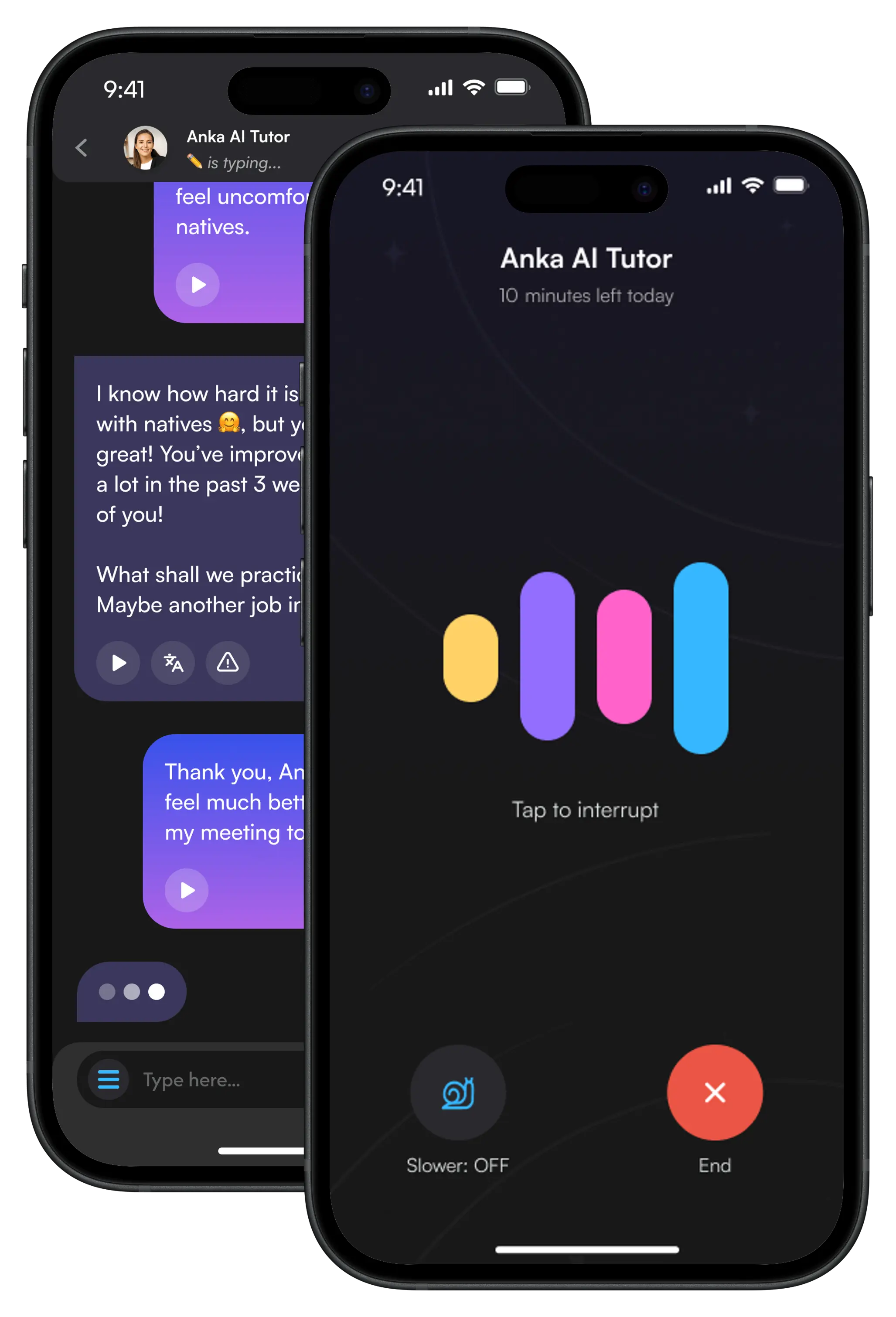
Step 4: Practice with AI Chatbots
AI tools are available 24/7 and provide a safe space to fail.
- Tools: Use ChatGPT's voice mode or Heylama AI to practice speaking, get instant grammar feedback and grow your vocabulary. The advantage of Heylama is that you don't need to be a prompt engineer to make it work. It has an integrated approach that gets you speaking and thinking in English form day 1.
- Routine: Spend 10-15 minutes daily. Start with simple prompts and then add more practice time as you get into a daily practice habit.
Step 5: Apply the Tight-Loose-Free Method
Don't just jump into complex conversations. Build up to them using this structure:
- Tight Practice: Repeat short sentences, changing one word at a time (e.g., "I like coffee" -> "I like tea" -> "I don't like tea"). Focus on accuracy.
- Loose Practice: Use new vocabulary in short stories or contexts.
- Free Practice: Engage in spontaneous conversation where the focus is on communication, not perfection.
Step 6: Find Real Conversation Partners
Ultimately, you need real interaction.
- Free: Use language exchange apps like HelloTalk or Tandem to find partners. Exchange 15 minutes of English for 15 minutes of your native language.
- Paid: Platforms like iTalki or Preply allow you to hire tutors for focused conversation practice.
Step 7: Create an Immersion Environment
You cannot learn to swim without getting wet. Immerse yourself digitally and physically.
- Change your tech: Set your phone and social media language to English.
- Passive vs. Active: Aim for 70% active practice (speaking) and 30% passive input (listening/reading) for the fastest progress.
Realistic Timeline: How Long Will It Take?
Many learners give up because they have unrealistic expectations. Moving from intermediate (B1/B2) to advanced fluency in English takes time and focused output.
- Conversational Fluency (B2): Requires approx. 600-750 hours of total study.
- Advanced Fluency (C1): Requires 900-1,000 hours.
Note: You do not need 10,000 hours. Consistent, deliberate practice cuts this time down significantly.
Conclusion: Start Speaking Today
The gap between understanding and speaking is normal, but it won't fix itself. You don't need to be perfect to be understood; you just need to be brave enough to start.
Your Next Step:Choose ONE method from this guide—whether it's talking to an AI for 5 minutes or shadowing a YouTube video—and do it today. Fluency comes from action, not preparation.
.png)

